Custom magnets · cut from blanks, not sintered here

A magnet shop that tells you which part it doesn't make.

Neodymium magnets are sintered by the plants that press the powder. What happens after that — cutting an arc that is not a catalogue disc, grinding a face to a tolerance, deciding which grade survives your operating temperature, coating it so it does not corrode — is where most small orders die. That is the part this shop runs.
Send a drawing Grade and temperature first
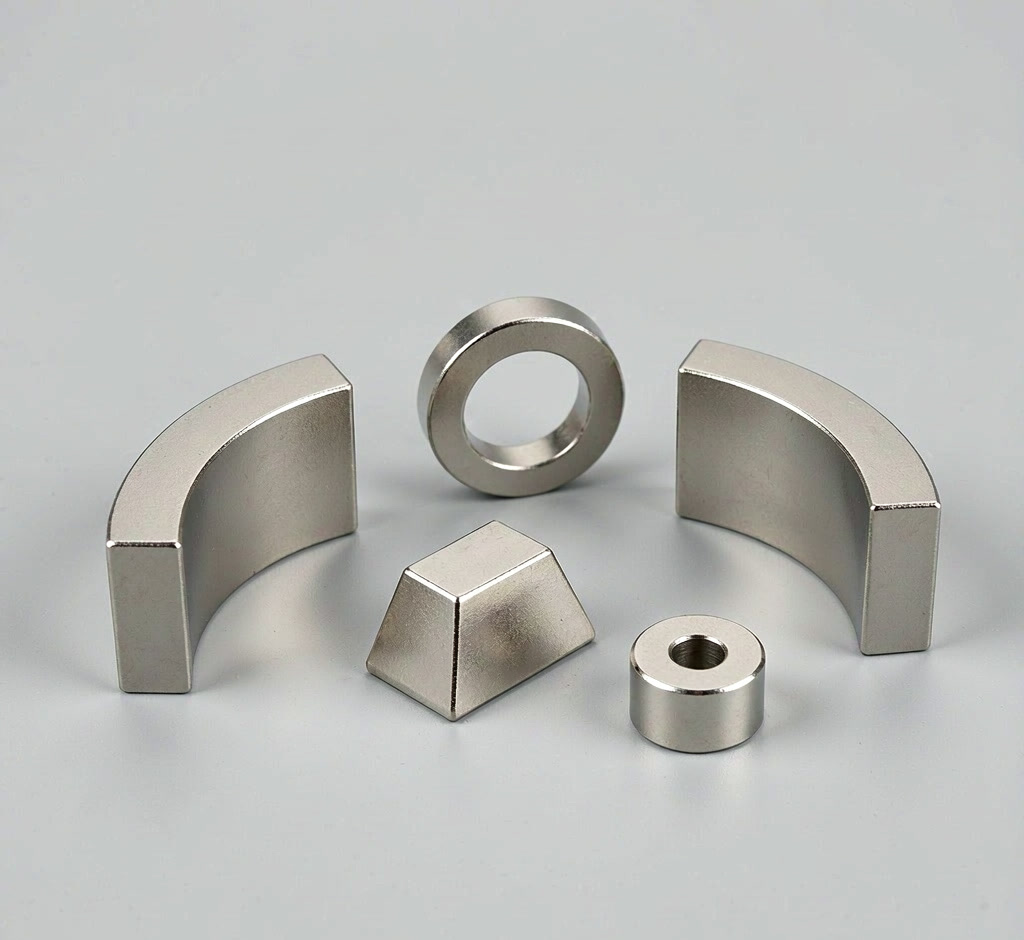
Sintered NdFeB magnets: arc segments, ring, block and cylinder

What is made here, and what is bought in.

Drawn as a line, because a magnet supplier that claims to do all of it is telling you something that is not true of anybody.

01 / Here

Cut, ground, drilled

Wire-cutting arc and tile segments from standard blocks, surface grinding to thickness, drilling and countersinking, chamfering to stop edge chipping.

02 / Coordinated

Sintering, coating, magnetising

The blank comes from a magnet plant. NiCuNi, epoxy and zinc coating run at a finishing shop. Magnetising is done after coating, to the direction on your drawing. All three appear on the quote as their own line.

03 / Measured

Dimensions, not flux

We measure what we make: dimensions, squareness, coating thickness on request. Magnetic flux is measured by the plant that magnetises, and their reading ships with the lot — we do not own a Helmholtz coil and will not pretend a caliper reading is a gauss value.

Grade and temperature decide more than the shape does.

The number everyone quotes is the maximum energy product — N42, N52. The number that decides whether your part still works in service is the temperature suffix, and it is the one most drawings leave off.

GradeMax operating temperatureWhat it costs youWhere it is the right answer
N (e.g. N42)about 80 °CCheapest per unit, strongest for its sizeRoom-temperature fixtures, sensors, holding work
Habout 120 °CSlightly lower energy product at the same sizeMotors and actuators that run warm
SHabout 150 °CNoticeably less flux per mm of magnetUnder-hood, near-coil, enclosed electronics
UHabout 180 °CThe most expensive route, and the thickestAnything that must not demagnetise on a bad day
SmCoabout 300 °CRoughly half the energy product of NdFeB, higher priceHigh temperature plus corrosion, where NdFeB coatings fail
Ferriteabout 250 °CWeak per unit volume, very cheap, no rare earthVolume parts where size does not matter

The temperatures above are the usual published figures for each class, not a measurement of your part. The figure that actually matters is your design's maximum magnet temperature, not ambient — a magnet next to a coil runs hotter than the room. If your drawing has no suffix, we will ask before quoting, because guessing here produces a part that passes inspection and fails in service.

Shapes and what they cost you.

Four shapes cover most of the work. The right column is where the money goes, not the difficulty.

ShapeHow it is madeTolerance we quote toWhat to watch for
Block, disc, ringGround from a standard blank±0.05 mm, ±0.01 mm on a ground faceRing wall under 1 mm deflects in the grinder
Arc / tile segmentWire-cut from a block, then ground±0.05 mm on chord and thicknessChord and included angle must both be on the drawing
Trapezoid, wedgeWire-cut±0.05 mmSharp corners chip; specify a chamfer or radius
Multi-pole magnetisedCut and coated, then magnetised to a pole patternPattern is set by the magnetiser, not by usThe pole pattern has to be drawn, not described in words

Tolerances above are this site's standard for magnets, quoted per feature after the drawing is read. They are not a promise that every shape holds every number: a 0.8 mm wall, a deep pocket or a 0.3 mm edge moves the achievable figure, and the quote says so before you commit.

Four things that fail after delivery, and the fix on the drawing.

Coating lifts at an edge

NiCuNi over a sharp wire-cut edge is thin at the corner and starts to blister in humidity. A 0.2 mm chamfer before coating costs almost nothing and is the difference between a five-year part and a one-year part.

Magnetising direction was never drawn

"Magnetised through thickness" is ambiguous on a trapezoid. Mark the axis with an arrow on the drawing. A part magnetised the wrong way cannot be corrected afterwards — the geometry is fine and the part is scrap.

The grade was chosen for the datasheet, not the duty

N52 in a 110 °C housing demagnetises and takes the assembly with it. If the temperature is unknown, say so at quoting: an H or SH grade that is slightly weaker is cheaper than a field failure.

Corrosion in an uncoated gap

NdFeB in a bare bore, or in a part that is cleaned with the wrong solvent, corrodes from the inside. If the part is washed or exposed, say so — epoxy or a passivated grade is a cheaper answer than a redesigned assembly.

What to send.

Enough to quote, not a full data pack. Five fields cover most magnet enquiries.

  • Shape and size — with a dimensioned sketch if there is no drawing.
  • Grade or the operating temperature — either one works, the temperature is the better one.
  • Magnetisation direction or pole pattern — an arrow, not a sentence.
  • Coating — or the environment it lives in, if you have not chosen one.
  • Quantity — first article plus batch, separately if they differ.
Accepted files: STEP, IGES, DXF, STL, or a PDF drawing.

What comes back: a price with grade, coating, magnetising and tolerance as separate lines, a ship date with its start point next to it, and a straight answer when the shape is one this shop should not quote.

Send the drawing, or send the requirement.

If the magnet is replacing one that no longer exists, send the dimensions you can measure and the duty it has to survive. That is enough to say whether it is a fit.

Send a drawing for review
Or email 4220015@gmail.com — two working days for a reply.