Neodymium magnets are sintered by the plants that press the powder. What happens after that — cutting an arc that is not a catalogue disc, grinding a face to a tolerance, deciding which grade survives your operating temperature, coating it so it does not corrode — is where most small orders die. That is the part this shop runs.
Drawn as a line, because a magnet supplier that claims to do all of it is telling you something that is not true of anybody.
Wire-cutting arc and tile segments from standard blocks, surface grinding to thickness, drilling and countersinking, chamfering to stop edge chipping.
The blank comes from a magnet plant. NiCuNi, epoxy and zinc coating run at a finishing shop. Magnetising is done after coating, to the direction on your drawing. All three appear on the quote as their own line.
We measure what we make: dimensions, squareness, coating thickness on request. Magnetic flux is measured by the plant that magnetises, and their reading ships with the lot — we do not own a Helmholtz coil and will not pretend a caliper reading is a gauss value.
The number everyone quotes is the maximum energy product — N42, N52. The number that decides whether your part still works in service is the temperature suffix, and it is the one most drawings leave off.
| Grade | Max operating temperature | What it costs you | Where it is the right answer |
|---|---|---|---|
| N (e.g. N42) | about 80 °C | Cheapest per unit, strongest for its size | Room-temperature fixtures, sensors, holding work |
| H | about 120 °C | Slightly lower energy product at the same size | Motors and actuators that run warm |
| SH | about 150 °C | Noticeably less flux per mm of magnet | Under-hood, near-coil, enclosed electronics |
| UH | about 180 °C | The most expensive route, and the thickest | Anything that must not demagnetise on a bad day |
| SmCo | about 300 °C | Roughly half the energy product of NdFeB, higher price | High temperature plus corrosion, where NdFeB coatings fail |
| Ferrite | about 250 °C | Weak per unit volume, very cheap, no rare earth | Volume parts where size does not matter |
The temperatures above are the usual published figures for each class, not a measurement of your part. The figure that actually matters is your design's maximum magnet temperature, not ambient — a magnet next to a coil runs hotter than the room. If your drawing has no suffix, we will ask before quoting, because guessing here produces a part that passes inspection and fails in service.
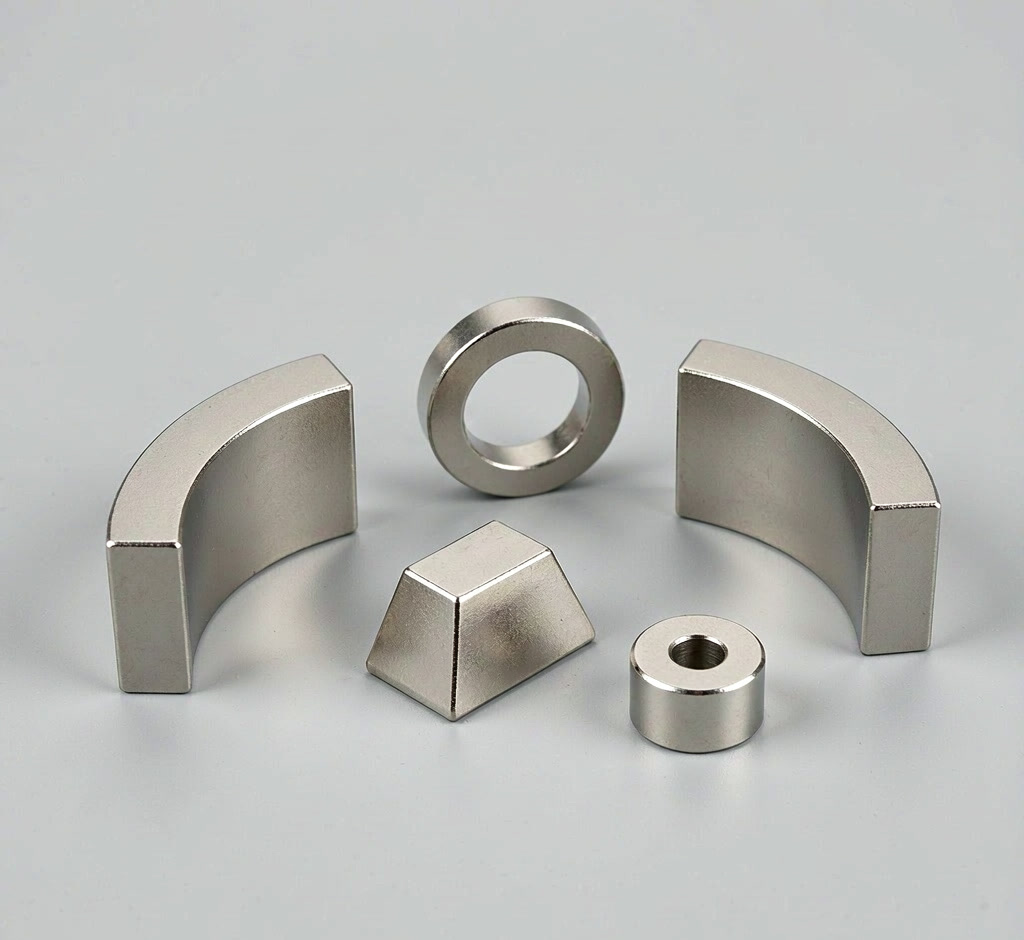
Four shapes cover most of the work. The right column is where the money goes, not the difficulty.
| Shape | How it is made | Tolerance we quote to | What to watch for |
|---|---|---|---|
| Block, disc, ring | Ground from a standard blank | ±0.05 mm, ±0.01 mm on a ground face | Ring wall under 1 mm deflects in the grinder |
| Arc / tile segment | Wire-cut from a block, then ground | ±0.05 mm on chord and thickness | Chord and included angle must both be on the drawing |
| Trapezoid, wedge | Wire-cut | ±0.05 mm | Sharp corners chip; specify a chamfer or radius |
| Multi-pole magnetised | Cut and coated, then magnetised to a pole pattern | Pattern is set by the magnetiser, not by us | The pole pattern has to be drawn, not described in words |
Tolerances above are this site's standard for magnets, quoted per feature after the drawing is read. They are not a promise that every shape holds every number: a 0.8 mm wall, a deep pocket or a 0.3 mm edge moves the achievable figure, and the quote says so before you commit.
NiCuNi over a sharp wire-cut edge is thin at the corner and starts to blister in humidity. A 0.2 mm chamfer before coating costs almost nothing and is the difference between a five-year part and a one-year part.
"Magnetised through thickness" is ambiguous on a trapezoid. Mark the axis with an arrow on the drawing. A part magnetised the wrong way cannot be corrected afterwards — the geometry is fine and the part is scrap.
N52 in a 110 °C housing demagnetises and takes the assembly with it. If the temperature is unknown, say so at quoting: an H or SH grade that is slightly weaker is cheaper than a field failure.
NdFeB in a bare bore, or in a part that is cleaned with the wrong solvent, corrodes from the inside. If the part is washed or exposed, say so — epoxy or a passivated grade is a cheaper answer than a redesigned assembly.
Enough to quote, not a full data pack. Five fields cover most magnet enquiries.
If the magnet is replacing one that no longer exists, send the dimensions you can measure and the duty it has to survive. That is enough to say whether it is a fit.
Send a drawing for review