Engineering plastics are where a prototype quietly becomes a product. The same drawing that costs $40 a part at fifty pieces can cost $6 at five hundred — but only if it was designed for a mould, and only after somebody pays for the tool. This page is about choosing the process honestly instead of defaulting to one.
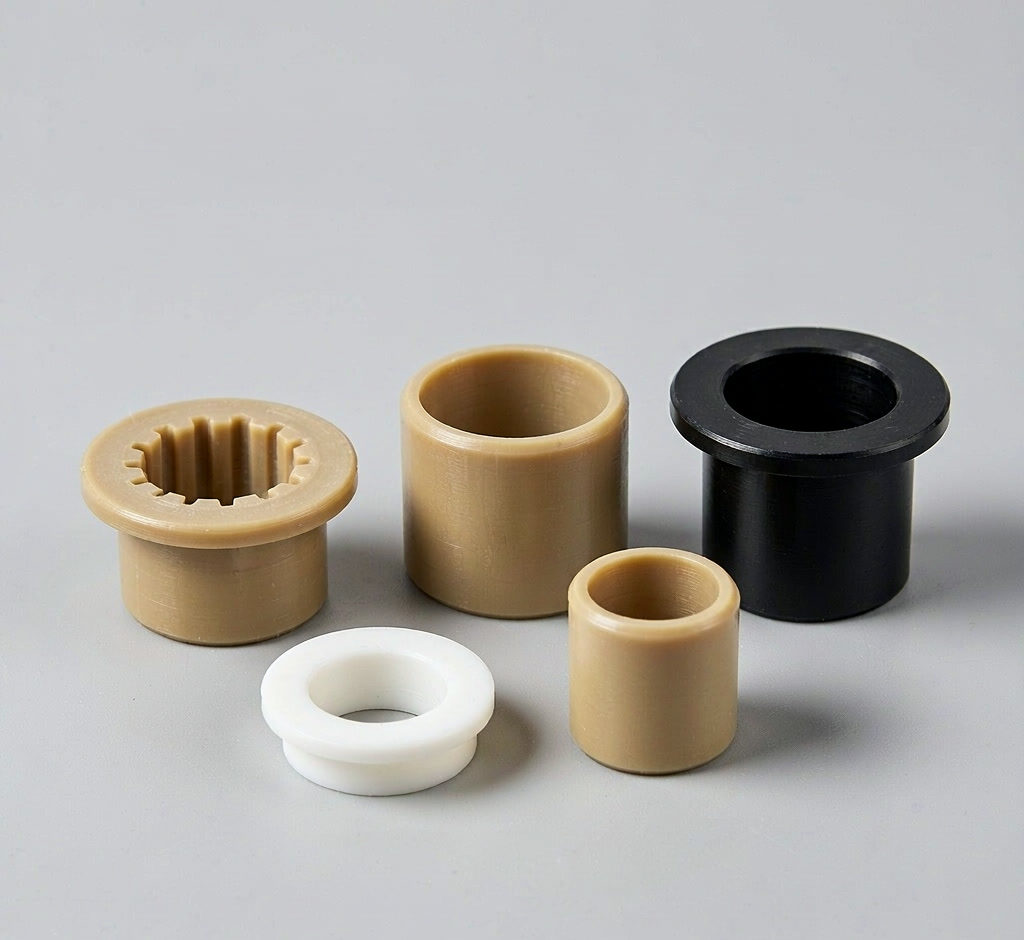
Listed with what each one is bad at, because the failure is usually the reason a part needs remaking.
| Material | Good at | Bad at | Typical part |
|---|---|---|---|
| PEEK (unfilled, GF30, CF30) | Temperature, creep, chemical resistance, wear | Cost; moves after machining unless annealed | Bushings, insulators, pump parts, wafer handling |
| PTFE | Lowest friction, widest chemical resistance | Cold flow under load, very high thermal expansion | Seal rings, gaskets, lab hardware |
| POM (acetal) | Dimensional stability, machinability, low moisture uptake | Acid resistance, UV, paint adhesion | Gears, cams, manifolds, jigs |
| PPS / PI | Temperature and dimensional stability, low outgassing | Brittleness, price, limited stock shapes | Semiconductor fixtures, high-temp housings |
These are material properties, not a claim that every shape in every material is available here. Stock shape and thickness decide what can be cut from what; if a 60 mm PEEK rod is not on the shelf, the quote says so rather than substituting a grade that behaves differently.
The crossover is usually somewhere between 100 and 300 pieces, and it depends on part size and on how much of the geometry a mould can actually form.
What this shop does not do: high-volume steel tooling, hot-runner production moulds, or family tools for a million shots. When your quantity passes what an aluminium tool makes economic sense for, the honest answer is to move the part to a production moulder — and we will say so.
A ±0.02 mm callout on POM is a different request from the same callout on aluminium. Here is what actually moves the number.
| Factor | What it does | What to put on the drawing |
|---|---|---|
| Thermal expansion | PTFE moves about ten times as much as steel per degree | The temperature the part is measured at, and the temperature it runs at |
| Moisture uptake | PA and POM grow in humid air; PEEK and PTFE barely move | Whether the part is measured dry or conditioned |
| Machining stress | Cutting releases locked-in stress; a pocket can bow hours later | Whether annealing is allowed, and whether the part must be stable over days |
| Creep under load | PTFE flows at room temperature under steady load | The load and whether it is continuous |
| Wall thickness | Thin walls deflect while being cut | A minimum wall, or permission to add support material |
Site standard for machined plastics is quoted per feature — commonly ±0.05 mm, tighter on a named feature where the material allows it. The number on the quote is the one that applies; a table cannot know whether your part is a 10 mm bushing or a 200 mm plate.
The cheapest moment to find out that a 0.8 mm wall will not fill, or that a bore needs a draft angle, is before the tool exists. That review is free and it comes back with the quote.
Send a drawing for review